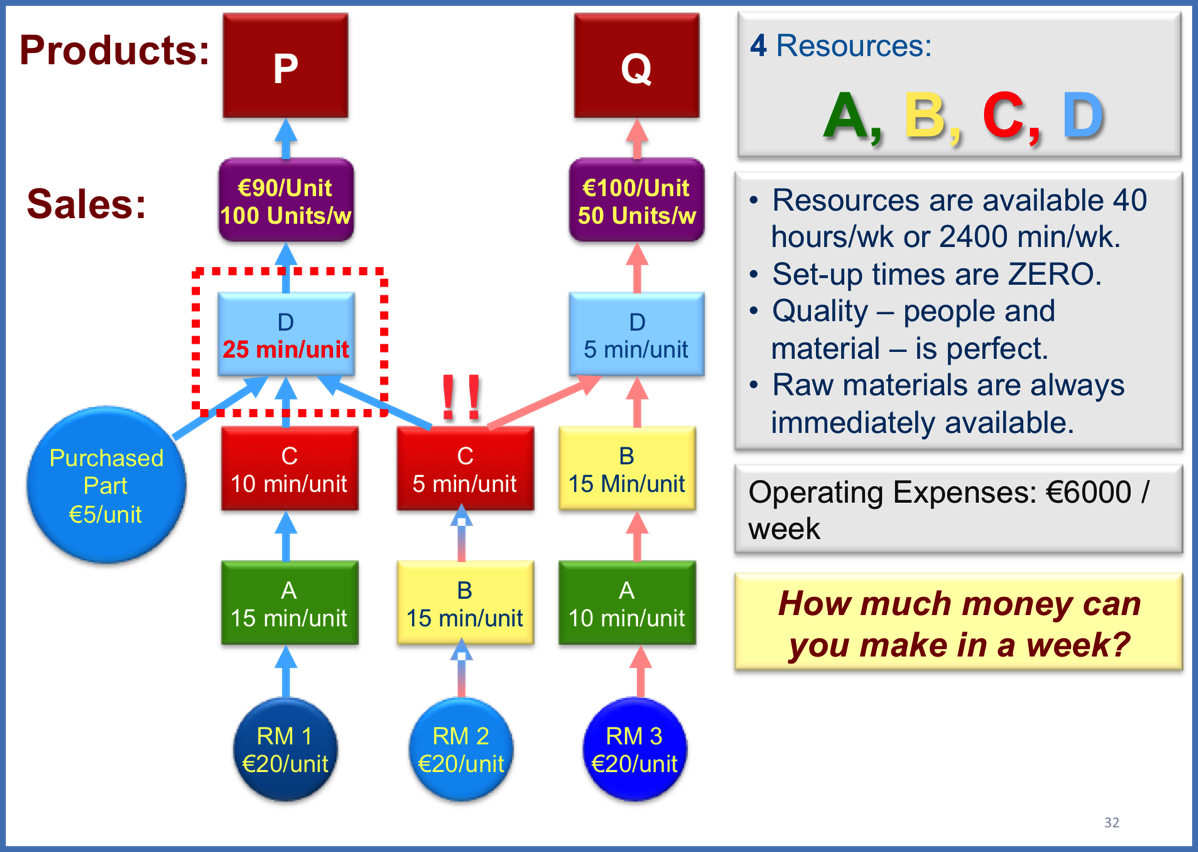
Alan Barnard (at the 2006 TOC-ICO conference) asked the question whether the simple Throughput per Constraint Unit rule is valid with 2 (or more) overloaded resources. Alan used Eli Goldratt’s P-Q thought experiment for his discussion. His question is important because it is common to see businesses reduce ‘excess’ capacities to balance (or almost balance) capacities. The practice often results in two) or more concurrent constraints or ‘almost’ constraints. Since 2006 I have observed several factories that wonder why their output collapses below the theoretical capacity of their (almost) balanced lines.
I plan to show that that the Throughput per Constraint Unit rule continues to be valid using the same P-Q thought experiment. I also want to discuss this result in relation to the real World – how should companies manage resource capacities.
I would like readers to follow Eli Goldratt’s recommendation that they solve the problems – before I provide the solution and before my discussion of results. The learning experience will be greater and readers should be better able to discuss and critique my conclusions. If you are familiar with the thought experiment you can jump to the second part of this article.
The key part of the article comes at the end when the solution used in the P-Q thought experiment is discussed in relation to REALITY. The thought experiment should not lead managers to an easy solution. The tool is useful but requires thought and care.
Reality
As Eli Schragenheim[1] says, “The problem is not mathematical, the problem is the assumption reality is linear.” AND, a second problem is the assumption that “reality is deterministic”.
The real World is of course quite different from our thought experiment. In a real situation, customers will not allow their suppliers to dictate what they buy. Customers will not wait to buy Q because we want to make sure all the P demand has fulfilled (the original P-Q experiment). In reality we are unlikely to ever achieve the optimum. This is especially so when you consider that a business does not sell just 2 products, but more likely in the hundreds if not thousands of products. So forget about ever reaching the optimum.
BUT, is it still possible to move sales in the direction of better constraint utilisation?
In a real example, a business protects their engineering constraint by favouring the sale of standard products requiring no engineering. Their second favourite products are those that require only a small amount of engineering. Their annual sales have always been, and still are, limited by engineering. However, since their sales focus has changed the maximum possible annual sales have increased and, in turn, the business has become more profitable. Added sales are realised without the need for added to operating expenses. All that happened is sales of those items that do not need (much) of the constraint have increased significantly – without creating a new second (interactive) constraint.
Another example of using the Throughput per Constraint Unit as a tool to help decide what to sell is the Aramid fibre business (Kevlar®, Twaron®, Technora® are examples of brand names). A wide variety of aramids are produced with different structures and different fibre strengths (different decitex or weight per 10’000meters). Not only do many different varieties exist; aramids are also used in many different applications like sailcloth, ropes, filtration, tires, brakes, protective clothing (bullet proof vests) and more. Prices will vary from application to application and, of course, the price per unit of weight varies according to the decitex of the product. Since the various applications are so different, the sales and marketing organisation is divided into profit centres – each competing for supply. All this would be no problem until the factory is sold out and product must be allocated to customers.
A business can allocate fairly – give everyone the same relative amount less than they need; a difficult thing to do since clients catch on quickly and will order more to protect their business. The aramid supplier can also look at his product line and favour those products with the highest Throughput per Constraint Unit. (There is a fair chance that the most favourable or unfavourable products are not those with the highest or lowest margins.) He can also use the situation to target those customers that pay the lowest price in terms of Throughput per Constraint Unit and raise prices in those markets; higher prices tend to reduce demand or the client realises that, higher prices are justified.
The sales organisation needs to know the situation in relation to Throughput per Constraint Unit. They cannot switch away from clients and markets or raise prices as easily as I write this, but they can have a tool to help decide what they should do; where they should focus their sales and pricing efforts for greatest benefit.
Throughput per Constraint Unit is a tool to help decide what to do. Other considerations are part of the decision – including things like the importance of certain clients. When multiple profit centres are involved the tool can help resolve which of the profit centres should get preferential supply.
Eli Schragenheims work to develop a decision support system may well become the tool for business managers to use. (see footnote.)
Conclusions
- The simple Throughput per constraint unit does not always work, so be very careful (think carefully) when you believe you should be using it.
- The 5 focusing steps remain an excellent guide to manage a business. They do not absolve management from some critical thinking about how to approach initiatives to increase sales or to improvement operations.
- Many companies, by trying to balance capacity for cost reasons, will often leave a lot of money on the table. Judging how much money is left on the table is not an easy task. It is easier to decide to have just one constraint and to decide where the constraint should be. The lost sales, Throughput and profit due to balanced capacity can far outweigh the additional cost for just one constraint or even the additional cost to move the constraint into the market.
- Throughput and the impact of decisions on Throughput should take precedence over thinking about and taking actions to manage (reduce) inventories and/or cost. (A business is here to make money, not to save cost. If you want to save cost, do not start a business!) BTW – that Throughput should take precedence does not mean inventories and operating expense are unimportant.
- To think about what to sell (what to favour when selling) is a discussion that involves most of a business. Finance and controlling should lead the discussion. Sales and production are key participants. The managing director should probably also participate – after all some pretty key decisions will be proposed and made during such a discussion. To do this, scenarios must be built based on experience, knowledge and intuition about the constraining elements and the direction and opportunities in market demand. Such scenarios can be built and compared (see Eli Schragenheim’s work with his DSTOC software).
- So far the sales and operations planning process was not mentioned in the article; but this process, if it exists in the company, is a good place for such discussions. A good place as long as the appropriate participants are present, as S&OP design says they should be.
[1] Below are 3 article titles in relation to Eli Schragenheims thinking and his work in the area. They are found on his blog (https://elischragenheim.com/) that is well worth reading. Look for the following article titles: 1.) The Non-Linear Behavior of the Cost of Capacity; 2.) Is it really an opportunity? and 3.) The TOC Key Decisions Support (DSTOC).